Propaganda in itself, I’ve learned, is to be able to persuade someone into doing something. The most effective way I saw the propaganda working was shame. Of course many of the posters pointed out how great it would be for you to do the things they wanted you to, but in the end some of the most powerful images had to do with how better off you were to participating, and you wouldn’t be good enough if you went without. The majority of the ones that annoyed me, got my attention, or were most effective were the ones that pointed out ‘You would do it if you were man enough’ to go for the army. Honestly this plays so much into how so many people are shamed into doing things today. Of course the objective is to show you why you’re better off for going to the army, but I saw that clearly guilting someone to doing something was highly effective. It makes the person want to show themselves not as weak, and stronger and strong enough to triumph over others. Also to point out that if someone is pointing at you, they’re more likely to listen, as Uncle Sam’s poster shows it being the most effective one to those who view it. Honestly I see no real tie into how the themes of the posters could tie into the culture of the specific nation, because I see it all in a more general sense of, “it’s better if you do and you’re damned if you don’t”.
Monthly Archives: February 2016
I Want You!
This week, we discussed the different sorts of propaganda used during WWI. The different tactics included emasculating the audience, invoking their national pride, promising romance and adventure, luring them in with beautiful women, and demonizing the enemy. I feel these methods were very effective, especially for the Allies. I think the most effective methods were emasculation, patriotism, and the demonizing. People tend to have a large amount of national pride, so getting them to fight in the name of their country wouldn’t be difficult. By proxy, demonizing the enemy would be a call to fight in the name of good. I also think that emasculating the audience would have been very effective because our societies have long ingrained the idea that a man should be manly and masculine. To call someone out for not being man enough would incite just the right amount of passion to get them to join. I definitely think these methods are still used today. We’re all aware of how many companies use sex to sell, so that hasn’t gone anywhere. We also still use a great amount of national pride, promoting products and services that are completely based in America.


The poster on the left is an example of American propaganda, which uses the emasculation method. It also speaks directly to the viewer, with clear lettering and a clear message in the photo. The photo on the right is an example of German propaganda, which is written in a difficult to understand typeface, and also, in my opinion, has an unclear picture. I think the Allies had a better propaganda effort based on the fact that their messages and images presented a clear picture and idea. I think the German propaganda was less clear, and incited less pathos in the audience than the Allies’ propaganda. Culture had to have played a role in the development of these distinct approaches. In terms of American propaganda, there is a great amount of national pride. Patriotism has always been one of our greatest values, and WWI was no different. The German propaganda clings to the ideas of old, as seen in the choice of typeface. That’s also a matter of national pride, and though it’s difficult to read, it was the go-to choice. The German posters appeal less to pathos, and at that time, it seems Germany was less about pathos and more about ruling.
I Gotta Give You PROP(S)ganda
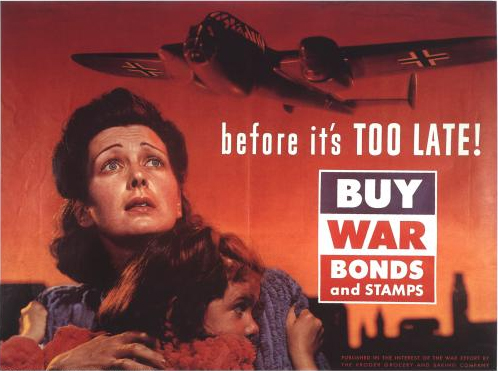
The main methods used for propaganda, in my opinion, is definitely fear and patriotism. When fear is used in propaganda, it is mainly used to make the target audience anxious and panicked. It can speak to people on a deeper emotional level, playing off the deep-seated fears and anxieties of the nation, and spurn people to action based on the probably non-existent (or at least overdramatized) threat. If you warn the entire United States of America that Germany just constructed an eight hundred-foot tall RoboHitler and that we have to bomb them to the ground before it’s unleashed, that’s more than likely going to scare at least some people.
Patriotism, on the other hand, will speak more to those that have a strong sense of nationalistic pride. Using this type of propaganda would include things like the burning of the American flag, immigrants illegally hopping over the border, soldiers in the military saluting, Uncle Sam, and several other things that I do not particularly agree with. It makes people furious at things that deem unpatriotic and causes them to be more willing to go to war for what they believe in. It definitely speaks to its intended audience. It also targets the unpatriotic, perhaps hoping to shame them into giving to the war effort if they cannot exactly fight.

The Power Of The Poster
There were many methods of propaganda used during the time of the first world war. Some of these included belittling men, using women and children to influence them to join the war, and also the loyalty of patriotism. They also made the war look more luxurious, like an adventure which we all know is not the case in any war.
To belittle men, they used posters or advertising that represent men that did not join the war as less manly. The made them feel as if they were not equal to the men that were fighting in the war. They used women and children to influence men to join by making images with little children asking their father to join or asking them to buy another bond for them like it was a present and not money to help fund the war.
Patriotism was represented by images of men joining and signing up to help fight the war. It was part of their patriot duty to lay down their life to fight in this war. And finally they used women to advertise how exciting it would be for men to travel. They made going to war look more like a trip and not something that could get them killed.
I believe that some of these are stilled used today, and I also believe that many of them would still work. Although I do not believe they could get war to look like an adventure. But now a day there are new way for them to influence people to join the arm or air force.
ProperGander
Propaganda is a tactic used by people to try to make them want to do something. Usually propaganda involves some kind of light slander, so when people look at it they will think “I can do that” or offend them so some extent to make them want to prove a point. Depending on what the message relays to the viewer it can be very effective today. You can still see elements of propaganda in TV commercials since everything is on TV or the internet. In my opinion, the Allies propaganda was better in term of their war propaganda, and I do believe they were the ones who started war propaganda. I think culture was involved in both sides of central and allied power’s propaganda, mainly their war propaganda since they wear their uniforms and in America’s case they used Uncle Sam as a reference. I find the war propaganda very interesting because it was the fact that armies were trying to recruit their civilians for wars and such. They apparently wanted to point out that if you didn’t want to go to war, you were a loser back then, at least that was some of the messages. Case in point, propaganda can be a very powerful tool for manipulating people.
Propaganda
Some methods for propaganda media were using big bold colors. In addition to using eye catching colors they also targeted their audiences directly with what the propaganda was saying. They spoke directly to either the man they wanted to serve or to their wives so they would push them into serving. Propaganda also made war seem like a way to provide for your family, especially your kids. Also, they showed war as an adventure and they made it seem like it was fun to travel and see the world. however the reality was that it was dirty and it was a rough environment that was nothing even close to t a fun filled adventure. I do think these methods were effective because generation after generation people enlisted despite the harsh conditions that were actually experienced while away at war. Some of these elements still seem present today. A lot of advertising for joining the army seems to be about bettering yourself and your family. Also they seem to make it look like a glorious adventure. And they also seem to speak directly to the audience of people they want to join instead of everyone in the general public. One thing that is different though is they seem to speak a lot more to women directly then they ever did before. The Allies and the Central Powers propaganda had a lot of similar elements that carried between the two of their propagandas. some differences were that the Allies used very realistic images and they used age appropriate people in their images. While the central powers used a lot of kids in their propaganda even as if the children themselves were enlisted in the war. I do think these differences were in part because of the cultural differences between these two groups of people.
Propaganda Manipulation
Propaganda was used to get men to enlist, for people to buy bonds and for general support for the war. Propaganda techniques varied by country. Many methods included emasculating message to weaken a man virility, trying to shame into going. Many tried romance and adventure, approaches also patriotic duty and a direct appeal. I think all the different methods were very effective. Some poster played the family card with the wife and child trying to get the father to go to war, gilt them in to enlisting.
The Canadian war posters had a Britain feel to then due to Britain having political and military control over Canada. They often used the union jack, were published in English and French and the posters addressed specific audiences. The United States before entering the war in 1917, a poster was created by James Montgomery Flag to get men enlisted for war. The famous poster was Uncle Sam “I want YOU for the U.S. Army.” The French poster tended to aim towards higher level of aesthetic. Were often designed by art school students and used traditional allegorical imagery towards the end promised war would end to reassure the public.
German posters didn’t turn away from modern abstract style. Weren’t really able to convey emotion impact through abstraction. The poster didn’t set well with the majority of Germans. They felt they would have won the war if they had done better with propaganda.
Art New View (Cont.)
Art Nouveau is a topic I really can’t speak much about. However, what I thought about this week’s art nouveau that differs from last week’s is that this week’s art was more culture based if that makes any sense. For example, Katie showed us two different pictures of the art nouveau category and wanted us to see which country we could relate it to. Taking that into account, it seemed like more of a cultural reference to me. It was pointed to me that each country had a different style to their paintings.
I do believe that a country’s culture does play a role in how their art nouveau develops. France and/or England’s art nouveau pictures I saw were mainly centered around women and the nature surrounding them. As well as Scotland tends to use more geometric looks to the art style. From what I can gather, the artists this week may have the same amount if not more influence than last week’s as well as the art styles established in that time, such as Werkstatte Style. If I had to decide which week’s art nouveau picture were better, I would say last week’s images for the sole fact that they had less disturbing images.
Propaganda and Design
Propaganda was a very popular design method for posters used during World War I to help influence fellow Americans to enlist into the Army, Navy, etc. A few different approaches were common to see when looking at different Propaganda posters. One was an American woman in the picture promoting the war and hoping her man would be man enough to go fight for his country. Another scenario includes different young men enjoying themselves across the sea traveling in Europe fighting for America, showing off the “fun adventure” of going to war. All in all, no matter how cheesy (or how untrue) these Propaganda designs were, they were effective. Especially compared to the Propaganda posters designed by the Central Powers, which were confusing and not very persuading. It is even said that their Propaganda designs were what made them lose the war. No matter if that is the truth or not, it is obvious that the Allies Propaganda poster designs were definitely more thought out than the Central Powers designs. One thing I think Allies’ Propaganda Posters helped bring to light in the design world is focusing on your audience. Focusing on your audiences emotions and what is important to them helps provide a strong message, which is exactly why Propaganda was so successful and still remembered today.
First World Language Problems
In class this week we had to develop our own language. It was very difficult on our own, but luckily we got to work in groups. I did come up with some ideas, but my classmates mainly did the work and I was just their for the ride. The challenge in this was coming up with our own symbols. Even though it was kind of tough to begin with, we made it even harder on ourselves by using symbols for words instead of letters. There was no real reasoning behind the symbols we chose, we just wrote down what popped into our heads. It’s actually funny how language has come a long way. Before the letters we just used pictures and symbols, which is pretty much what ties into the exercise, and it also shows how much humanity has evolved in the past few centuries or so. It was pretty fun make our own alphabet, but if there was one thing I didn’t like it was probably that we could’ve done symbols for letters instead of taking a more difficult route for each word, but nevertheless it was fun. It was very interesting to learn about how much language has changed over the years.